

Client Overview
One of India’s fastest-growing banks strengthened its identity and access security using an IAM solution from Binary Global. By implementing SSO, MFA, Zero Trust access, and automated user lifecycle management, the bank reduced fraud risks, improved access control, and achieved RBI and DPDP compliance.
Business Challenges
As the bank grew, managing millions of accounts became difficult. Its old security systems could not keep up with new threats, compliance rules, and increasing users.
Higher Fraud Risk : A 49% rise in fraud showed that password-based security was not enough to stop phishing and account takeover.
Compliance Pressure : New laws like the DPDP Act 2023 and RBI guidelines required stronger access control and better security.
Scattered User Data : User identities were spread across Active Directory, SaaS apps, and contractor accounts, making management complex.
Outdated Security Systems : Older systems could not handle growing users and modern cyber threats, making security management more difficult.
Slow Processes : Manual user management delayed onboarding and increased errors.
Poor User Experience : Multiple logins and frequent password resets reduced productivity and increased IT workload.
IAM Solution Architecture
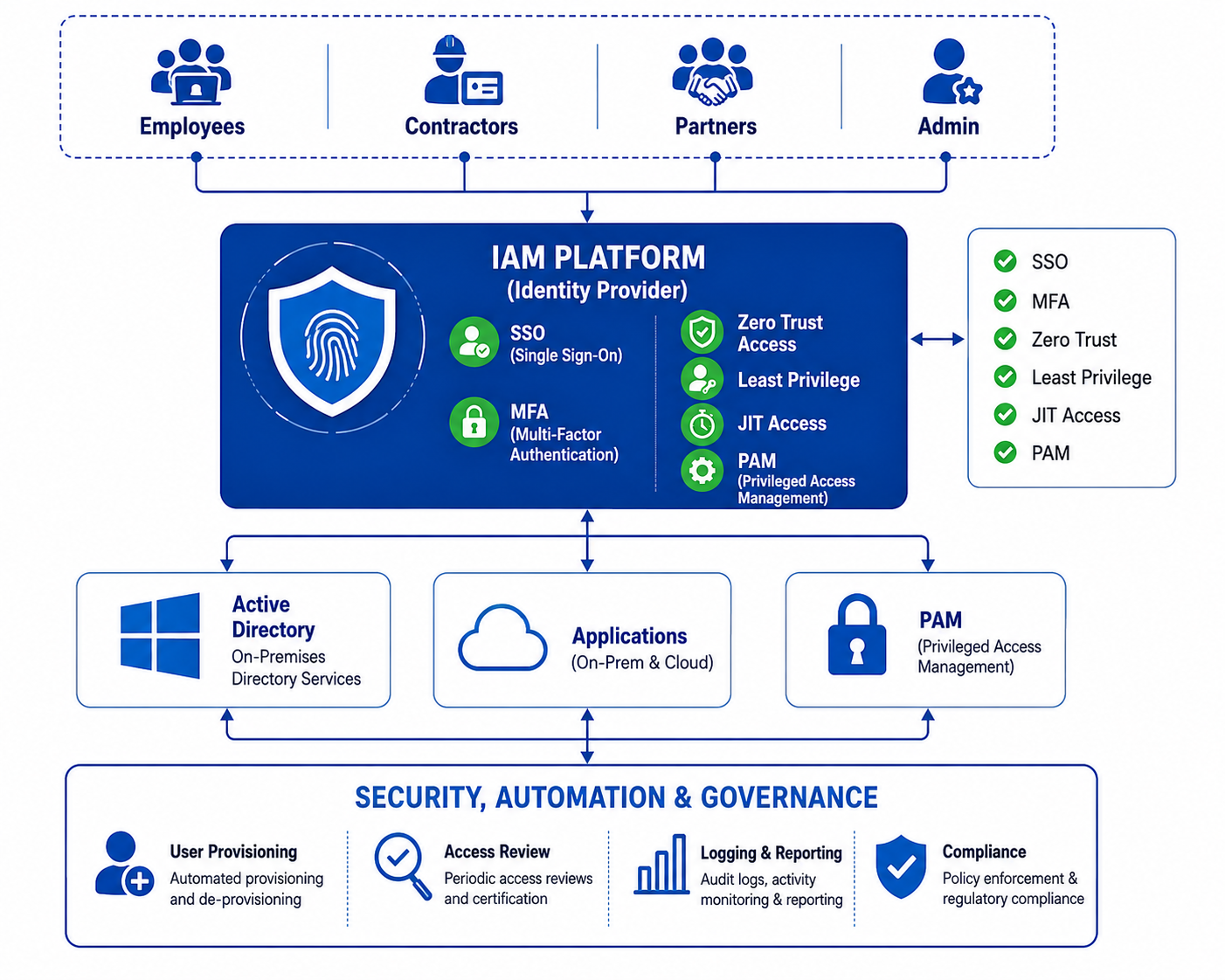
A centralised IAM system was used to manage all users in one place across on-premises and cloud. Active Directory was connected to cloud apps to enable secure SSO, making access simple and consistent.
The system used least privilege so users only get the access they need. JIT access was given to admins only when required. MFA was added for all users to improve security.
With automated user management and regular access checks, the bank improved control, reduced risks, and met RBI and DPDP Act 2023 requirements.
Core IAM Technologies Used
MFA
(Multi-Factor Authentication):
Adds an extra layer of security using OTP, tokens, or passwordless login to protect
PAM
(Privileged Access Management):
Provides admin access only when needed and for a limited time, reducing the risk of misuse.
User Provisioning:
Automatically creates, updates, and removes user accounts, making user lifecycle management faster and more accurate.
Identity Provider
Handles login and enables SSO, so users sign in once and securely access all applications without multiple passwords.
Machine & API Access:
Secures connections between systems, applications, and APIs to prevent unauthorized access.
Logging & Reporting:
Tracks user activity, maintains audit logs, and helps meet security and compliance requirements.
IAM Implementation Approach
Business Impact and Security Improvements
Moving to a unified IAM system with Binary Global improved security, efficiency, and compliance. With SSO, MFA, and least privilege, the bank reduced fraud and secured access. Automation made onboarding faster and reduced manual work. It also helped meet RBI and DPDP Act 2023 requirements easily.
Faster Employee Onboarding :
Employee setup time dropped from 4 days to under 4 hours using automated joiner–mover–leaver workflows. New hires could start work much faster.
Fewer Helpdesk Requests :
With SSO and MFA, users faced fewer login issues, reducing password reset requests and IT workload.
Reduced Fraud :
Strong authentication and real-time checks helped block unauthorized access and minimise fraud risks.
Improved Admin Security :
Just-in-time (JIT) access removed permanent admin rights, reducing the chances of privileged account misuse.
High MFA Adoption :
Almost all active users adopted MFA, strengthening overall identity security.
Full Compliance :
The bank achieved full compliance with the DPDP Act, moving from manual