

The Challenge: Securing Hybrid-Cloud Infrastructure
In 2026, cyber risks increased as businesses used both cloud and on-premise systems. This made security more complex in hybrid cloud environments and harder to manage.
The client was a mid-sized FinTech company. It received many security alerts every day. Many alerts were false, which made it hard to find real threats. Some threats stayed hidden, creating serious risks.
Identity Security: The company used old VPN systems. These were not enough for modern security. It required a Zero Trust (ZTNA) approach, where every user and device are verified before access is granted.
Visibility: The company could not see all systems clearly. This included AWS and on-premise setups. There were many blind spots. Attackers could operate without being noticed.
Old Systems: Some systems used outdated PowerShell. These systems were not updated. They had known weaknesses. Attackers could easily exploit them.
Compliance: The company needed proper logs to meet DORA and PCI-DSS 4.0 rules. But the logs were not complete, so audits were difficult.
Overall, the company required a stronger security approach. It required to reduce risks, improve visibility, and meet compliance requirements.
Detection Strategy: AI-SIEM for Ransomware Detection
Modern SOC systems focus on how things behave, not just on known threats. This helps detect new and hidden attacks that traditional tools miss.
Trigger: The AI system noticed unusual activity in the network. It identified a “Living off the Land” (LotL) attack, where attackers use trusted tools to stay hidden.
Indicator: PowerShell, which is a normal admin tool, started acting in a strange way. It connected to an unknown IP address, which raised a security alert.
XDR Integration: The system combined data from network traffic and endpoint logs. This helped the managed SOC team quickly confirm a web shell attack in real time and act.
Incident Response Lifecycle (NIST Framework)
The SOC team followed the NIST Incident Response framework to handle the attack in a clear and structured way. This helped them detect, analyse, and stop the threat quickly.
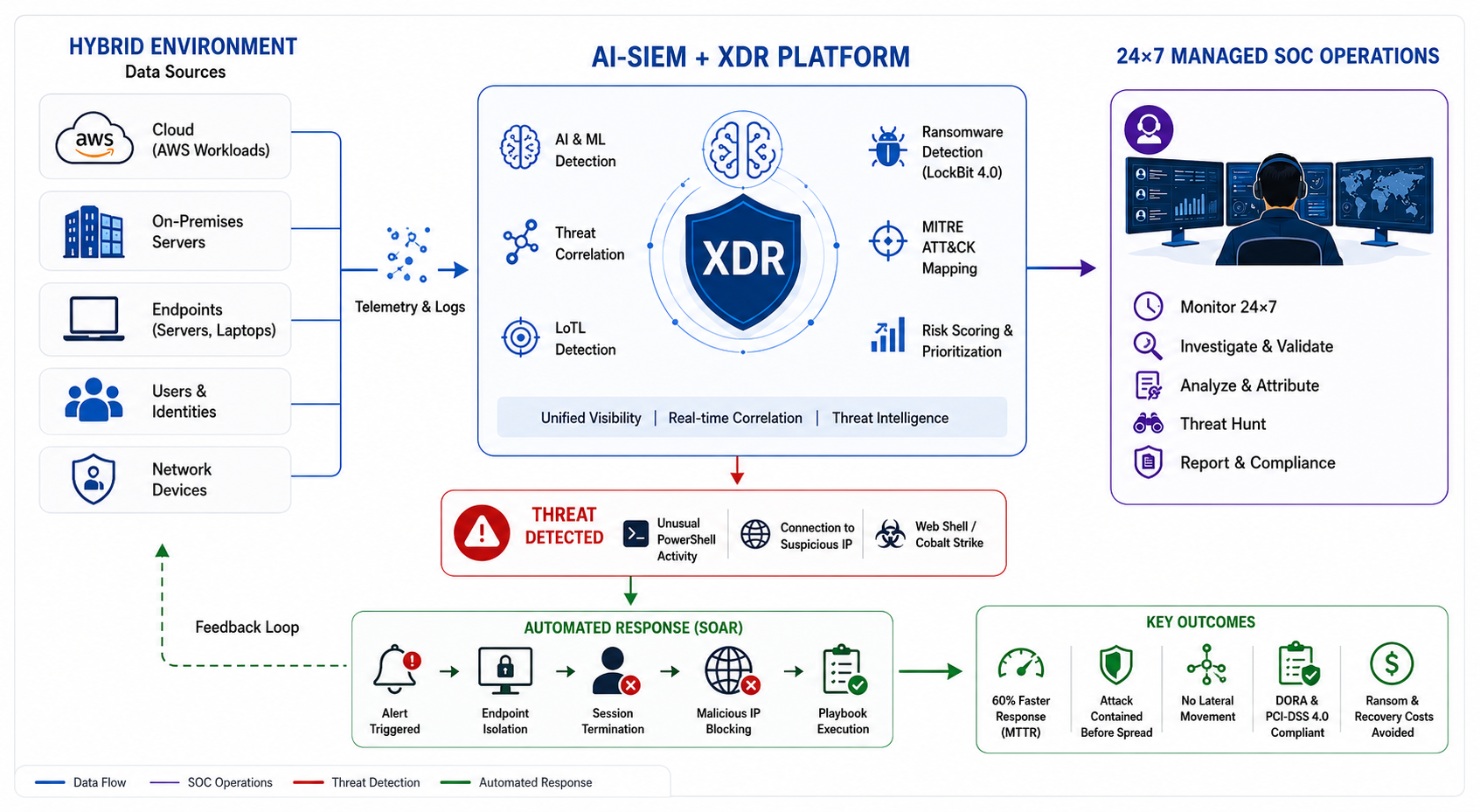
Key Findings: SOC Performance Metrics & ROI & Ransomware Protection
Cybersecurity success depends on how fast a threat is detected and how quickly it is handled. In this case, the SOC team showed strong performance across all key areas.
Overall, the Managed SOC monitoring services helped protect the business, reduce risk, and save costs.
Why Continuous SOC Monitoring Matters
Traditional security tools act after an attack happens. This can delay response and increase damage. It also makes it harder to control the situation quickly.
Binary Global’s Managed SOC team helped detect and stop threats early. Our team monitored systems 24/7 and responded in real time. This reduced risks and prevented attacks from spreading.